Mesh Generation
- Home /
- Categories /
- Mesh Generation
GaMeS: Mesh-based adapting and modification of Gaussian Splatting
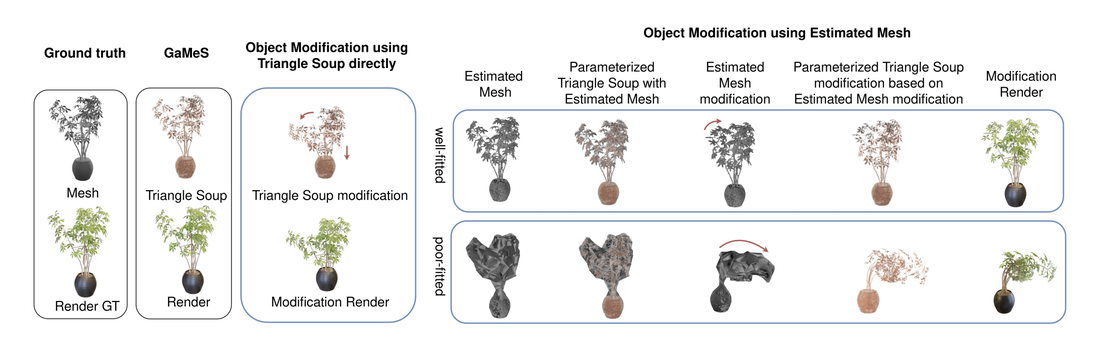
Abstract Gaussian Splatting (GS) is a novel, state-of-the-art technique for rendering points in a 3D scene by approximating their contribution to image pixels through Gaussian distributions, warranting fast training and real-time rendering. The main drawback of GS is the absence of a well-defined approach for its conditioning due to the necessity of conditioning several hundred thousand Gaussian components. To solve this, we introduce the Gaussian Mesh Splatting (GaMeS) model, which allows modification of Gaussian components in a similar way as meshes. We parameterize each Gaussian component by the vertices of the mesh face. Furthermore, our model needs mesh initialization on input or estimated mesh during training. We also define Gaussian splats solely based on their location on the mesh, allowing for automatic adjustments in position, scale, and rotation during animation. As a result, we obtain a real-time rendering of editable GS.
Read More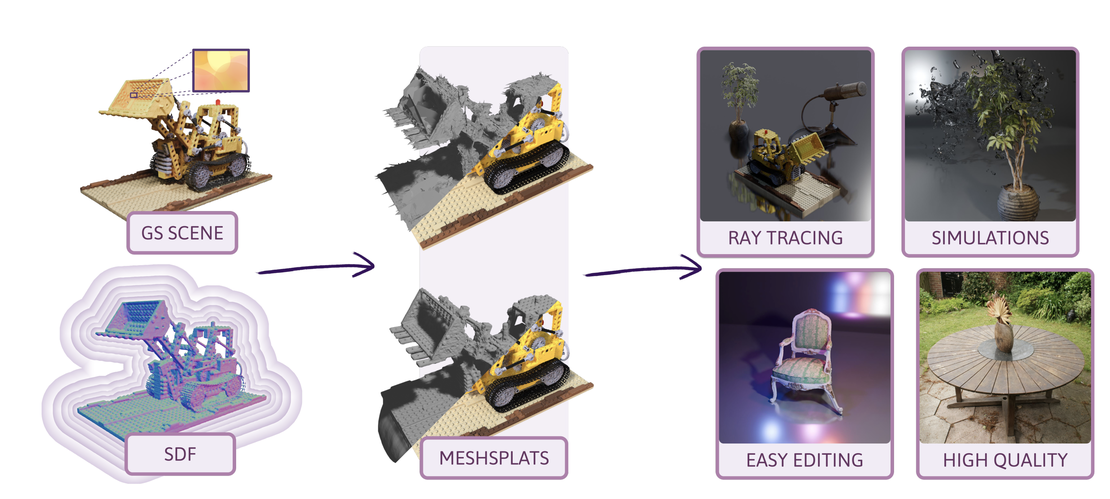
MeshSplats: Mesh-Based Rendering with Gaussian Splatting Initialization
Abstract Gaussian Splatting (GS) is an emerging, pivotal technique in 3D computer graphics. Most GS-based algorithms exclude the use of classical methods such as ray tracing, which offer numerous inherent advantages in rendering. For example, ray tracing can handle incoherent rays for advanced lighting effects, including shadows and reflections. To address this issue, we introduce MeshSplats, a method which converts GS to a mesh-like format. Following the completion of training, MeshSplats transforms Gaussian elements into mesh faces, enabling rendering using ray tracing methods with all their associated benefits. Our model can be used immediately after transformation, yielding a mesh without additional training, with only a slight reduction in reconstruction quality. We can enhance the quality by applying a dedicated optimization algorithm that operates on mesh faces rather than Gaussian components. Importantly, MeshSplats acts as a wrapper, converting pre-trained GS models into a ray-traceable format. The efficacy of our method is substantiated by experimental results, underscoring its extensive applications in computer graphics and image processing.
Read More