QuantumGS: Quantum Encoding Framework for Gaussian Splatting

QuantumGS: Quantum Encoding Framework for Gaussian Splatting

Table of Contents

Abstract

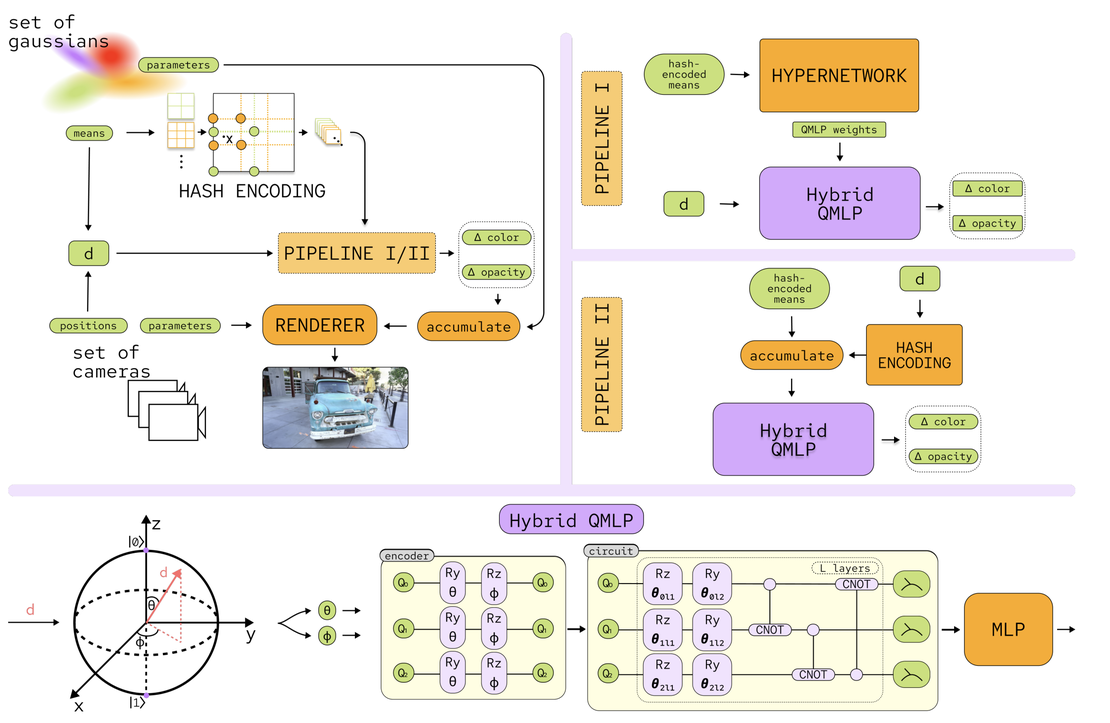
Recent advances in neural rendering, particularly 3D Gaussian Splatting (3DGS), have enabled real-time rendering of complex scenes. However, standard 3DGS relies on spherical harmonics, which often struggle to accurately capture high-frequency view-dependent effects such as sharp reflections and transparency. While hybrid approaches like Viewing Direction Gaussian Splatting (VDGS) mitigate this limitation using classical Multi-Layer Perceptrons (MLPs), they remain limited by the expressivity of classical networks in low-parameter regimes. In this paper, we introduce QuantumGS, a novel hybrid framework that integrates Variational Quantum Circuits (VQC) into the Gaussian Splatting pipeline. We propose a unique encoding strategy that maps the viewing direction directly onto the Bloch sphere, leveraging the natural geometry of qubits to represent 3D directional data. By replacing classical color-modulating networks with quantum circuits generated via a hypernetwork or conditioning mechanism, we achieve higher expressivity and better generalization.

Paper: Click here to read
DOI: https://doi.org/10.1007/978-3-032-36226-1_20
Code: https://github.com/gwilczynski95/QuantumGS
Related Posts

GaMeS: Mesh-based adapting and modification of Gaussian Splatting

GaMeS: Mesh-based adapting and modification of Gaussian Splatting

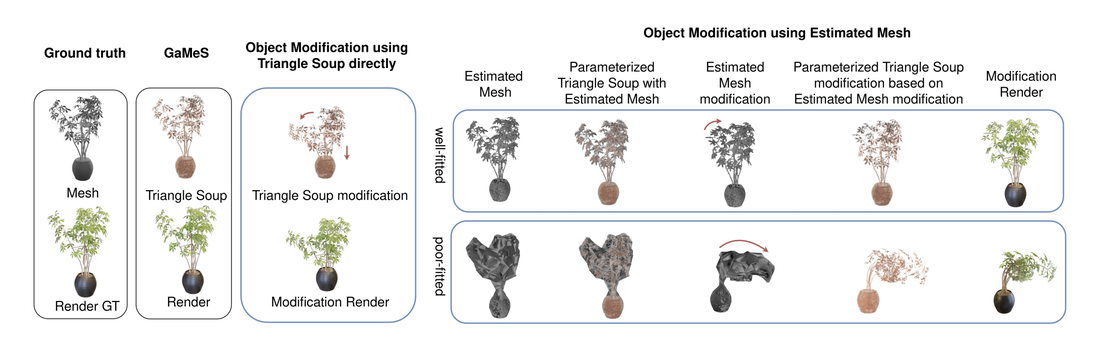
Abstract Gaussian Splatting (GS) is a novel, state-of-the-art technique for rendering points in a 3D scene by approximating their contribution to image pixels through Gaussian distributions, warranting fast training and real-time rendering. The main drawback of GS is the absence of a well-defined approach for its conditioning due to the necessity of conditioning several hundred thousand Gaussian components. To solve this, we introduce the Gaussian Mesh Splatting (GaMeS) model, which allows modification of Gaussian components in a similar way as meshes. We parameterize each Gaussian component by the vertices of the mesh face. Furthermore, our model needs mesh initialization on input or estimated mesh during training. We also define Gaussian splats solely based on their location on the mesh, allowing for automatic adjustments in position, scale, and rotation during animation. As a result, we obtain a real-time rendering of editable GS.

Read More

University–Hospital Collaboration Conference (Kraków, 3 December 2025)

University–Hospital Collaboration Conference (Kraków, 3 December 2025) On 3 December 2025, the Krakow Specialist Hospital of St. John Paul II hosted the conference “University–Hospital Collaboration – New Opportunities” at the Conference and Training Center (Pavilion A5) in Kraków.

Read More
LumiMotion: Improving Gaussian Relighting with Scene Dynamics

LumiMotion: Improving Gaussian Relighting with Scene Dynamics

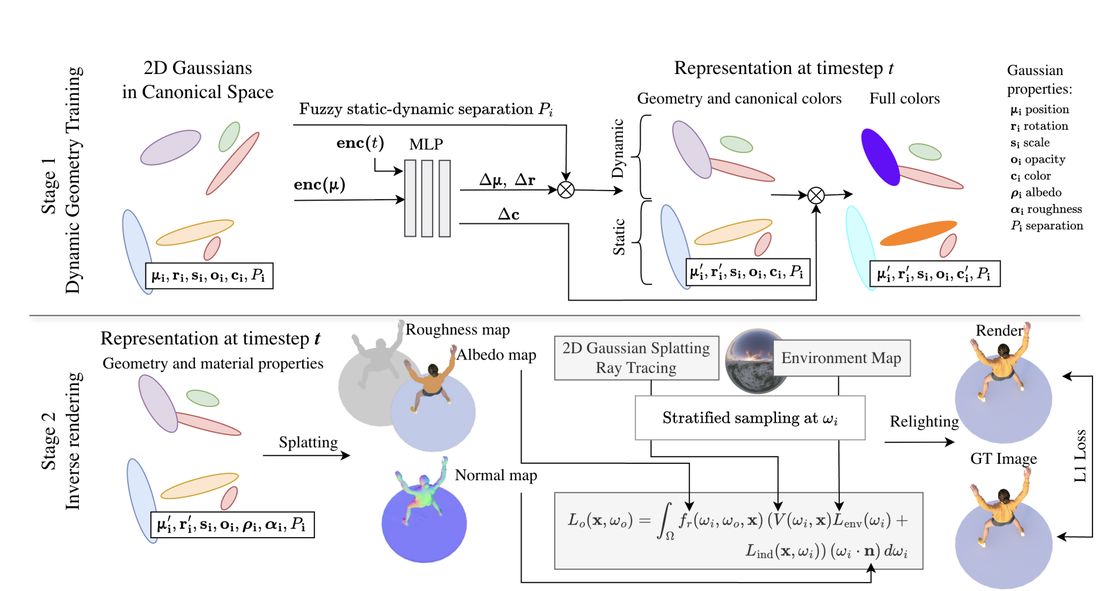
Abstract In 3D reconstruction, the problem of inverse rendering, namely recovering the illumination of the scene and the material properties, is fundamental. Existing Gaussian Splatting-based methods primarily target static scenes and often assume simplified or moderate lighting to avoid entan- gling shadows with surface appearance. This limits their ability to accurately separate lighting effects from mate- rial properties, particularly in real-world conditions. We address this limitation by leveraging dynamic elements– regions of the scene that undergo motion–as a supervisory signal for inverse rendering. Motion reveals the same sur- faces under varying lighting conditions, providing stronger cues for disentangling material and illumination. This the- sis is supported by our experimental results which show we improve LPIPS by 23% for albedo estimation and by 15% for scene relighting relative to next-best baseline. To this end, we introduce LumiMotion, the first Gaussian-based approach that leverages dynamics for inverse rendering and operates in arbitrary dynamic scenes. Our method learns a dynamic 2D Gaussian Splatting representation that em- ploys a set of novel constraints which encourage the dy- namic regions of the scene to deform, while keeping static regions stable. As we demonstrate, this separation is crucial for correct optimization of the albedo. Finally, we release a new synthetic benchmark comprising five scenes under four lighting conditions, each in both static and dynamic variants, for the first time enabling systematic evaluation of inverse rendering methods in dynamic environments and challenging lighting.

Read More