GaMeS: Mesh-based adapting and modification of Gaussian Splatting

GaMeS: Mesh-based adapting and modification of Gaussian Splatting

Table of Contents

Abstract

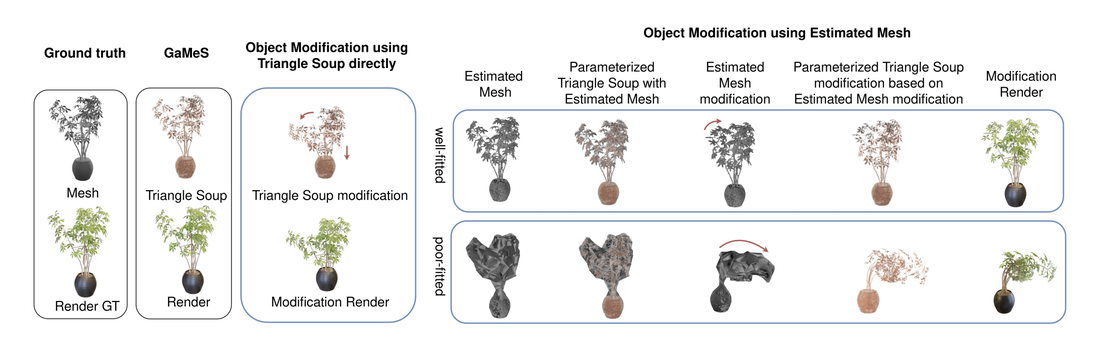
Gaussian Splatting (GS) is a novel, state-of-the-art technique for rendering points in a 3D scene by approximating their contribution to image pixels through Gaussian distributions, warranting fast training and real-time rendering. The main drawback of GS is the absence of a well-defined approach for its conditioning due to the necessity of conditioning several hundred thousand Gaussian components. To solve this, we introduce the Gaussian Mesh Splatting (GaMeS) model, which allows modification of Gaussian components in a similar way as meshes. We parameterize each Gaussian component by the vertices of the mesh face. Furthermore, our model needs mesh initialization on input or estimated mesh during training. We also define Gaussian splats solely based on their location on the mesh, allowing for automatic adjustments in position, scale, and rotation during animation. As a result, we obtain a real-time rendering of editable GS.

Paper: Click here to read
DOI: https://doi.org/10.1016/j.patcog.2026.114561
Code: https://github.com/waczjoan/gaussian-mesh-splatting
Related Posts

University–Hospital Collaboration Conference (Kraków, 3 December 2025)

University–Hospital Collaboration Conference (Kraków, 3 December 2025) On 3 December 2025, the Krakow Specialist Hospital of St. John Paul II hosted the conference “University–Hospital Collaboration – New Opportunities” at the Conference and Training Center (Pavilion A5) in Kraków.

Read More
HuSc3D: Human Sculpture Dataset for 3D Object Reconstruction

HuSc3D: Human Sculpture Dataset for 3D Object Reconstruction

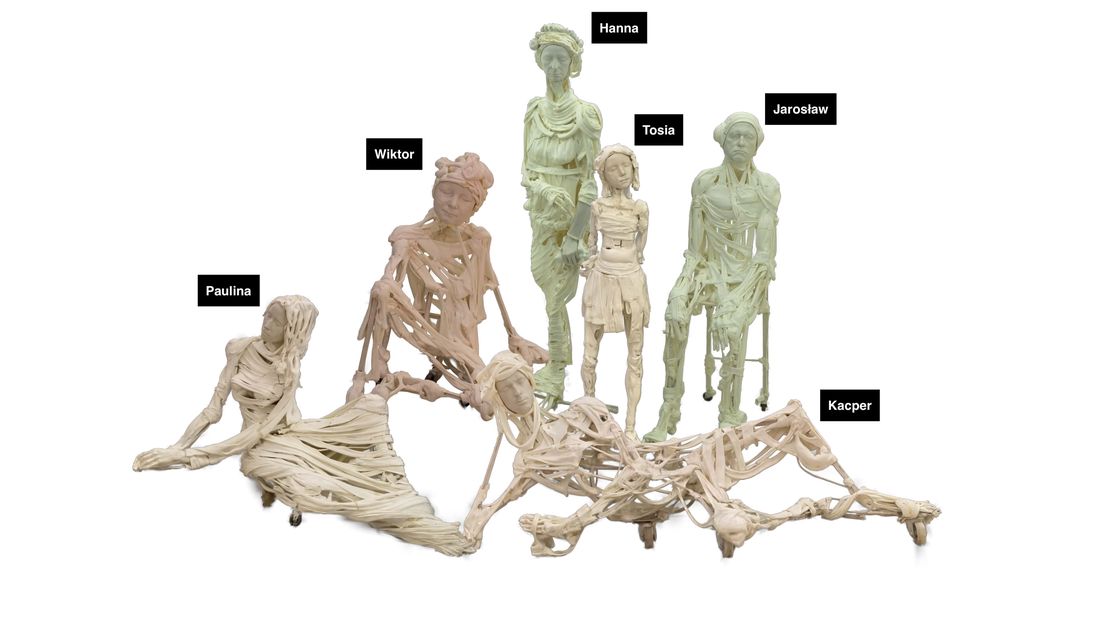
Abstract 3D scene reconstruction from 2D images is important tasks in computer graphics. Unfortunately, existing datasets and benchmarks concentrate on idealized synthetic or meticulously captured realistic data. Such benchmarks fail to convey the inherent complexities encountered in newly acquired real-world scenes. In such scenes the background is often dynamic, and by popular usage of cell phone cameras, there might be discrepancies in, e.g., white balance. To address this gap, we present HuSc3D, a novel dataset specifically designed for rigorous benchmarking of 3D reconstruction models under realistic acquisition challenges. Our dataset features six highly detailed, fully white sculptures characterized by intricate perforations and minimal textural variation. Furthermore, the number of images per scene varies significantly, introducing the additional challenge of limited training data for some instances alongside scenes with a standard number of views. By evaluating 3D reconstruction methods on this diverse dataset, we demonstrate the distinctiveness of HuSc3D in effectively differentiating model performance, particularly highlighting the sensitivity of methods to fine geometric details, color ambiguity, and varying data availability – limitations often masked by more conventional datasets.

Read More
PR-ENDO: Physically Based Relightable Gaussian Splatting for Endoscopy

PR-ENDO: Physically Based Relightable Gaussian Splatting for Endoscopy

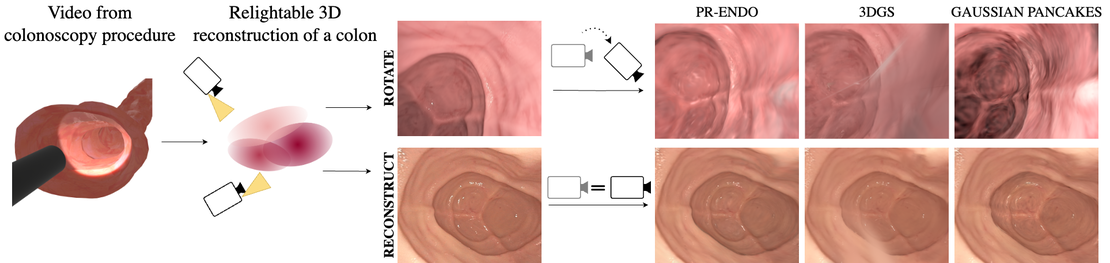
Abstract Endoluminal endoscopic imaging—used in diagnosing colorectal cancer and other internal diseases—stands to benefit greatly from accurate 3D reconstructions and novel-view synthesis. However, current methods struggle with artifacts due to constrained camera trajectories and lighting effects that depend heavily on view, often overfitting and failing when viewing from novel angles.

Read More