HuSc3D: Human Sculpture Dataset for 3D Object Reconstruction

HuSc3D: Human Sculpture Dataset for 3D Object Reconstruction

Table of Contents

Abstract

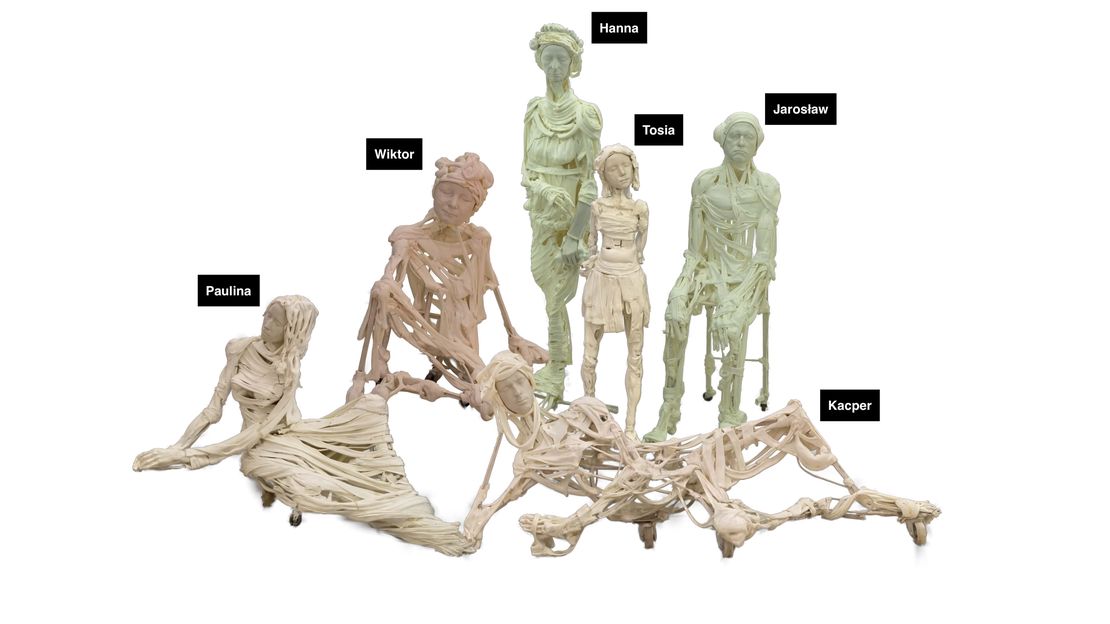
3D scene reconstruction from 2D images is important tasks in computer graphics. Unfortunately, existing datasets and benchmarks concentrate on idealized synthetic or meticulously captured realistic data. Such benchmarks fail to convey the inherent complexities encountered in newly acquired real-world scenes. In such scenes the background is often dynamic, and by popular usage of cell phone cameras, there might be discrepancies in, e.g., white balance. To address this gap, we present HuSc3D, a novel dataset specifically designed for rigorous benchmarking of 3D reconstruction models under realistic acquisition challenges. Our dataset features six highly detailed, fully white sculptures characterized by intricate perforations and minimal textural variation. Furthermore, the number of images per scene varies significantly, introducing the additional challenge of limited training data for some instances alongside scenes with a standard number of views. By evaluating 3D reconstruction methods on this diverse dataset, we demonstrate the distinctiveness of HuSc3D in effectively differentiating model performance, particularly highlighting the sensitivity of methods to fine geometric details, color ambiguity, and varying data availability – limitations often masked by more conventional datasets.

Paper (ICCS 2026): Click here to read
DOI: https://doi.org/10.1007/978-3-032-29924-6_54
Project Page: https://wmito.github.io/HuSc3D/
Related Posts

LumiMotion: Improving Gaussian Relighting with Scene Dynamics

LumiMotion: Improving Gaussian Relighting with Scene Dynamics

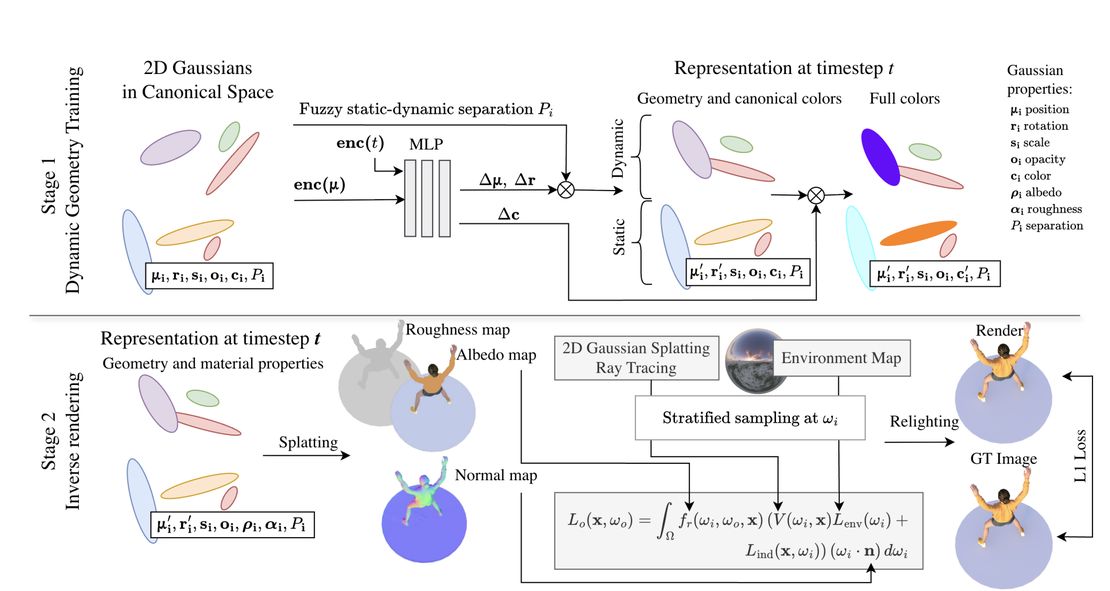
Abstract In 3D reconstruction, the problem of inverse rendering, namely recovering the illumination of the scene and the material properties, is fundamental. Existing Gaussian Splatting-based methods primarily target static scenes and often assume simplified or moderate lighting to avoid entan- gling shadows with surface appearance. This limits their ability to accurately separate lighting effects from mate- rial properties, particularly in real-world conditions. We address this limitation by leveraging dynamic elements– regions of the scene that undergo motion–as a supervisory signal for inverse rendering. Motion reveals the same sur- faces under varying lighting conditions, providing stronger cues for disentangling material and illumination. This the- sis is supported by our experimental results which show we improve LPIPS by 23% for albedo estimation and by 15% for scene relighting relative to next-best baseline. To this end, we introduce LumiMotion, the first Gaussian-based approach that leverages dynamics for inverse rendering and operates in arbitrary dynamic scenes. Our method learns a dynamic 2D Gaussian Splatting representation that em- ploys a set of novel constraints which encourage the dy- namic regions of the scene to deform, while keeping static regions stable. As we demonstrate, this separation is crucial for correct optimization of the albedo. Finally, we release a new synthetic benchmark comprising five scenes under four lighting conditions, each in both static and dynamic variants, for the first time enabling systematic evaluation of inverse rendering methods in dynamic environments and challenging lighting.

Read More
MiraGe: Editable 2.5D Image Representations with Flat-Controlled 3D Gaussians

MiraGe: Editable 2.5D Image Representations with Flat-Controlled 3D Gaussians

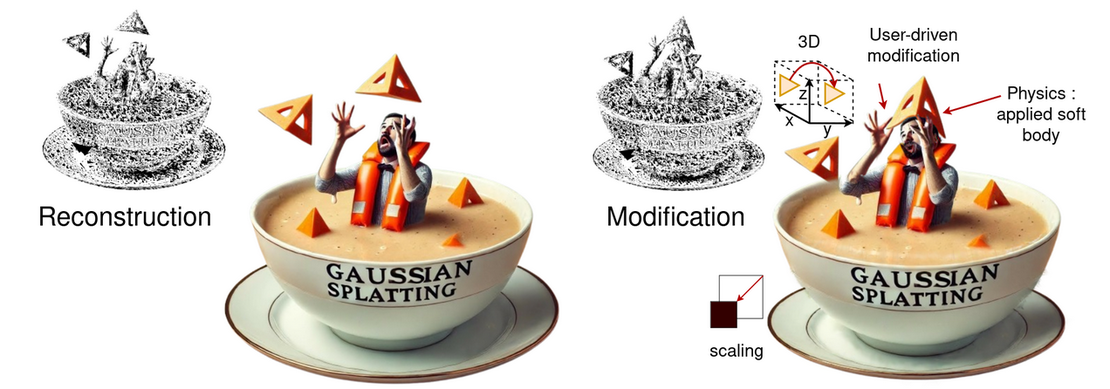
Abstract Implicit Neural Representations (INRs) encode images as continuous functions that map pixel coordinates to RGB values, achieving compact storage and high visual fidelity. Recent work such as GaussianImage replaces neural MLPs with collections of 2D Gaussian primitives, reaching similar reconstruction quality and compression but offering limited editability. In practice, creators often need to adjust content—move objects, bend a photo, cast new shadows, or create parallax—all of which are awkward within purely 2D or purely additive Gaussian schemes.

Read More
CLIPGaussian: Universal and Multimodal Style Transfer Based on Gaussian Splatting

CLIPGaussian: Universal and Multimodal Style Transfer Based on Gaussian Splatting

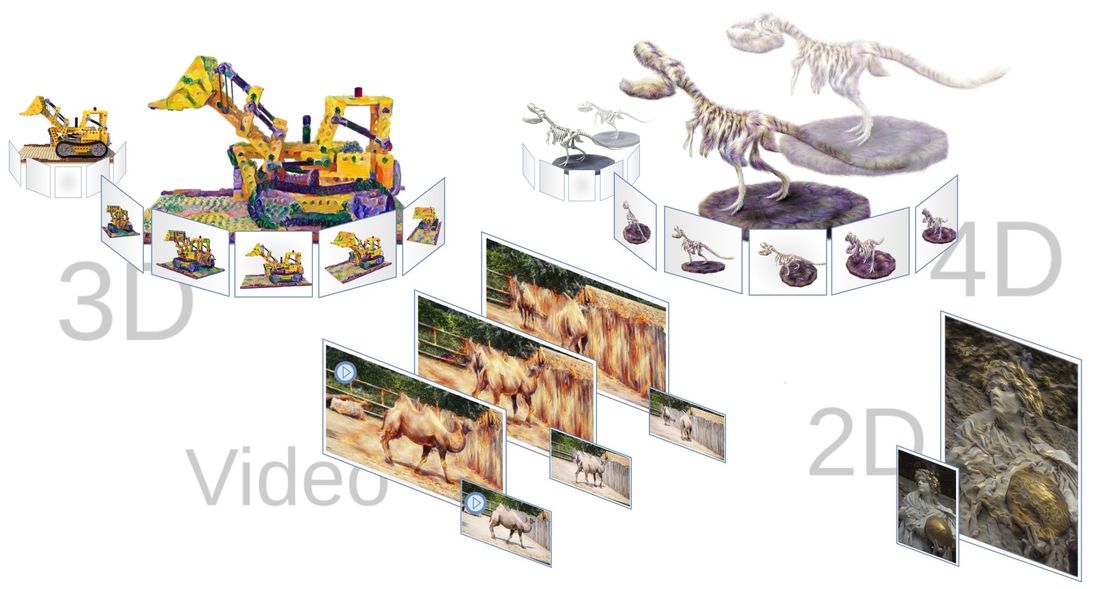
Abstract We present CLIPGaussian, a framework that performs universal, multimodal style transfer by operating directly on Gaussian primitives—the shared representation underlying modern 2D, 3D, and 4D Gaussian Splatting pipelines. Instead of relying on heavy generative models, CLIPGaussian uses CLIP-driven text and image cues to steer both the appearance and, when beneficial, the geometry of Gaussian elements. This makes stylization a geometric-aware process: colors shift in locally meaningful ways, textures reorganize to match the target style, and structural details adapt subtly without disrupting the underlying scene. Because the method works natively on Gaussian fields, the same mechanism seamlessly applies to single images, complex 3D objects, temporally coherent videos, and dynamic 4D reconstructions.

Read More